
Master's in Speech Language Pathology
The Master’s Program in Speech Language Pathology at UL Lafayette is fully accredited by the Council on Academic Accreditation in Audiology and Speech-Language Pathology (CAA) of the American Speech-Language-Hearing Association. This means that the core program is very much like master’s in speech pathology programs at universities across the nation. As in any other accredited program, you will meet the academic requirements for the ASHA Certificate of Clinical Competence in Speech-Language Pathology (CCC-SLP). You will have the specified number of clinical hours in a variety of clinical settings, and the coursework will be sufficient to cover the depth and breadth of knowledge you will need.
So how is our master's in speech pathology program different? What makes a degree from UL Lafayette special? Why not let our alumni tell you? We’ve gathered exit survey data and comments from the most recent alumni groups from our 2024-2026 cohorts
1. Supportive, Passionate, and Accessible Faculty
Students consistently identified faculty and supervisors as the program’s greatest strength. Faculty were viewed not only as educators but also as professional role models who instilled confidence, motivation, and empathy. Students consistently highlight the supportiveness and availability of faculty and supervisors. This open-door policy encourages collaboration and mentorship, enhancing the overall learning environment. Students identify faculty excellence as the cornerstone of the program’s success. The instructors’ blend of expertise, mentorship, and humanity creates a deeply positive learning climate and directly contributes to professional readiness.
Illustrative Comments:
2. Strong Academic and Theoretical Foundation with Integration of Theory and Practice
Students perceive the curriculum as academically rigorous and theoretically comprehensive. Students value the intellectual rigor of the program and recognize its emphasis on scholarly preparation. The curriculum is viewed as preparing students to think critically and engage with evidence-based practice. Students praise the program’s balance of theoretical grounding and applied clinical practice, its constructivist and holistic philosophy, as well as the emphasis on evidence-based and client-centered approaches. Students specify that faculty effectively connect theory to current research and clinical examples, helping students bridge classroom and clinic.
Illustrative Comments:
3. Strong Overall Satisfaction and Emotional Connection to the Program
Students identify faculty excellence as the cornerstone of the program’s success. The instructors’ blend of expertise, mentorship, and humanity creates a deeply positive learning climate and directly contributes to professional readiness. Many comments reflected deep appreciation, gratitude, and emotional investment in the program. Faculty were viewed not only as educators but also as professional role models who instilled confidence, motivation, and empathy. The emotional and interpersonal culture of the CODI program—rooted in respect, care, and collaboration—is a major contributor to student satisfaction and should remain protected in any program changes. The overwhelmingly positive tone suggests students experience the program as not only academically valuable, but personally meaningful and professionally transformative.
IllustrativeComments:
We also listen to suggestions for change! We use the same student feedback to help refine and enhance our program, including a recent revision to our required MS courses, while staying aligned with accreditation standards.
At UL Lafayette, classroom and clinic operate collaboratively, but the master's in speech pathology curriculum drives the clinical practices our students use. This means you will be able to transfer what you learn in the classroom directly to therapy in the clinic. We believe our commitment to helping our students translate theory and research into clinical practice while forming supportive, emotional connections sets us apart.
Collaboration
Our academic faculty is involved in the clinic, and our clinical faculty often attend academic classes with the students. You can especially see this collaboration in the summer when academic and clinical faculty jointly supervise in one of our popular group projects.
As a student, you may be working with school-aged children in our successful summer literacy project or with groups of adults with aphasia on conversational and literacy-related skills. Perhaps you will get to work with adolescent and preschool fluency groups, or groups for children who use AAC devices to communicate, or social groups for high functioning children on the autism spectrum. 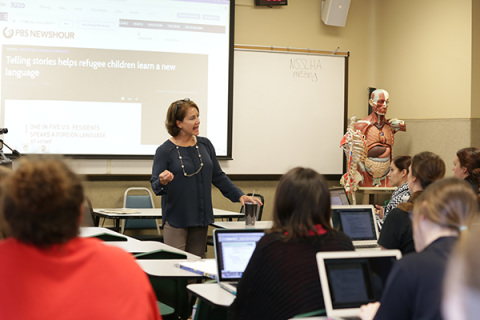
The key is that each group is structured and facilitated by both academic and clinical faculty members who have expertise in those areas.
This program prepares its students for licensure or certification within the state of Louisiana. Please visit the list of licensure programs for important information if you plan to move out of state.